Bu Blogda Ara

half-marathon etiketine sahip kayıtlar gösteriliyor. Tüm kayıtları göster

04 Mart 2012

The Philosophy of Running

There is no such a thing! There is no philosophy behind running because it is not different from smoking or writing. It is an addiction and like all addictions, if you don't take your daily/weekly dosage, you start feeling uneasy, uncomfortable and perhaps apprehensive. I should also add that not all addictions fit to everyone so running may not be for everyone either. Obsessions cannot be shared so do addictions! People run for different reasons. Some run for health, some run for challenge, some run for the feeling of satisfaction they get at the end of the exhausting process. It is the endorphin (the runner's high) which gives a happy end to the story. The body exhausts itself, sacrifices a lot of sweat, salt and energy in order to reach a point which is probably wired in our roots for millions of years. Some scientists claim this is the "survival instinct" as we run to safety or run to catch food in the past. Once we reach our target, we feel satisfied or exhilarated.

One day before the run, resting my legs and having coffee.

As I said above, people run for variety of reasons. I am not different from others. I too run to be happy at the end, to reach the feeling of an accomplishment after a long and tiring experience, to forget the reminiscent of the daily stress and of course to sleep well once I close my eyes in the bed. So far, it achieves its targets and when one day running does not any more give me these advantages, I will stop.


At Meze Turkish Restaurant with Turkish guys.

Today's run was nice but it wasn't as nice as my first half-marathon in Cambodia. I am not sure what caused the frustration but somehow I felt a bit disappointed with the things or with the chain of unfortunate events. Let me start with the beginning.

Last night was fun. I met with Turkish guys at the Meze Turkish Restaurant in Nha Trang. We had some nice Turkish food and I had a glass of red wine. This is nothing compared to what I ate and drank in Cambodia (2-3 bottles of beer) one night before the run. I didn't eat heavy things as I didn't want to have trouble with my stomach during the next morning. The ambiance was nice, the conversations were full of thoughts, politics, literature and unique life experiences. In order to make sure I will have enough rest, I left the restaurant at 10 pm and went to bed as soon as I arrived at my room. However, my sleep was disturbed with two worrisome dreams.

In the first dream, I woke up at 6 am. Knowing that the race starts at 6:10, I was scared of being late. I hurried wearing my shoes, shorts, race number etc and went out to find only no one is at the start point. One guy with a red T-shirt told me that they are all gone and now I can only run the 10 k because they will start at 6:30. In the second dream, I woke up at 5 am, everything went fine but when I arrived to the start point, I notice that I don't have my shoes. I see some young guys warming up behind the start point with no shoes. They laugh at me and at the same time they welcome me in their group. Although I tell them "I cannot run without shoes, it will hurt my knees terribly", they say "khong co chi" (never mind).

Despite the dreams, I wake up at 5 am as I planned and went to the start point with my shoes. When I got up the bed, I felt a bit sleepy but this feeling disappeared as soon as I left the room and walked in the dark streets of Nha Trang. The streets were full of people, running, walking, stretching. The interesting thing was these people are not going to run any marathon. This is the normal picture of this city early in the mornings. People wake up at 5 am and go to the beach to have exercises till the sunrise. How amazing! How beautiful!

Once I arrived to the start point, time was only 5:40 am. I did warming up, ran up and down to the beach and stretched my legs as much as possible to prevent possible cramps which can bring ultimate pain to my sleeps later on. However, time was 6:10 already when a Japanese guy came to the stage to give his speech. After he read his speech from a paper, a Vietnamese guy came to the stage and he also read his speech from a paper. By the time both finished their talks, it was 6:30 am. Making us late for their nonsense speech -no one listens to them anyway- can be explained by only their invincible ego. I haven't heard an English word although half of the runners seem to me non-Vietnamese and non-Japanese. The only English word came at the end was "marathon" which is probably borrowed from Greek in every language.

Then they told us to get in a queue! I thought they are gonna train us for a military exercise. After we got in queues, they told us to walk back to the start point so we can go backward. Surely we did what we were told. After a few minutes more waiting, the a loud bang suddenly erupted and we started running. It sounds normal to start late if this was a ceremony or some sort of book reading meeting. But starting a marathon 30 minutes late is disastrous! When I come to the point of 3 k, the sun was already rising on my right side and the weather was already hot. If we had started 30 minutes earlier as the schedule suggested, I would be having this heat at 8th k. So this was the first disappointment. We started 1-0 behind.

Second problem was that the organizers did not really try to make sure the runners will be running on a safe road. During the whole run, people with motorbikes came behind me and passed me. They were not the police, they were normal citizens. But the road is supposed to be closed to the traffic for a few hours so that we can run without worrying about what is coming behind us. One can be sure that runners after 10 k become very feeble creatures, it is impossible to respond to the sudden change of direction or speed of a motorbike coming behind us once our legs become full of ants, biting our flesh, once our bodies become full of sweat, pouring down like a waterfall. Besides, the guys on racing motorbikes were supposed to control the roads and make sure that no one enters the road except for occasional ambulance and camera crew car. But they were speeding on the same road! I can swear that some of them were speeding with 100-150 km/h just to enjoy the relative freedom of closed traffic! So no matter how you run, there is a motorbike with a roaring engine right behind you and scares you to death as it might hit you or any other runner on the road if you wanna take over the guy in front of you or if you just want to change your lane! If I wanted to be bothered by the speeding motorbikes, why would I come to Nha Trang to run a marathon. I have them in Phu My Hung too. In fact, I can say that the path I run around my building is safer than the path I ran today.

Third problem -although nobody can do anything about it- was heat. I am not used to run in the mornings. I usually run after 5-6 pm so I can continue running even after the sunset. Running is the morning seems like wasting all day for me. Once you run, you want to have rest. But I cannot have rest in weekdays so I will feel tired all day. This is why I run in the evenings, after coming back from work to empty my mind, to get tired physically for a sound sleep. However, there is no marathon in the world which starts in the afternoon. As far as I know all marathons start early mornings. When I did the half-marathon in Cambodia, I enjoyed it as it was through a nice park and the ruins of Angkor Wat. There was a lot of shade to get comfort. On Nha Trang beach, there was nowhere to hide. The sun was baking my head and sucking all the energy from my calves. I felt almost like a sponge squeezed to nothing in order to produce water! Especially after the 15 k, I almost walked but didn't stop. Thanks to the time I saved in the first half by running fast, my slow run in the second half was not so bad and I finished the race at my targeted time.


There was nothing the organizer can do to cool down the running path but surely they had a lot of things to do at the end point of the race. Unfortunately, there was no any parasols or any large shade either. The runners needed to lay down on the grass in the sun or on the asphalt in order to cool down. There was only one thin shade line which was under the red arch of the race start/end point and it was occupied by the security forces. So the runners are left with the sun and grass!!!

I am finishing the race, behind the guy with white shirt.

Realizing that it is impossible, most left the scene for their hotels or homes as soon as they finish the race. Unfortunately, there was no ambiance of celebration or social networking among the runners. It would have been nicer if runners from different parts of the world talk to each other and exchange a few words about their experience. However, doing this in the sun is impossible, especially after a 21 km running process.

No shade around so I used the start point arch as my royal tent.

Finally, Nha Trang half-marathon is left behind now. Time to prepare for the next one. It will be in Phuket in June so there is a lot of time to prepare. Let's wait and see if I can hit 1:55 h in Phuket. This time I will be ready for the heat. I am sure pain will never go away but I can manage to keep the suffering at certain boundaries by practice and determination.


21 Aralık 2011

Running Through the Past

“Pain is inevitable, suffering is option” says Haruki Murakami, a well-known novelist and a long-distance runner. Running, like all other sports, requires mental discipline and physical endurance. One cannot even run 10 km without the proper training, as otherwise things might go very wrong and long-lasting injuries might occur.

We went to Cambodia to complete a half-marathon. The goal of the run is both to arrange a big sports movement and to help the long-time suffering people of Cambodia. The location is perfect as the route is passing through the ruins of the Angkor temples, going along a small lake, reaches at some dirt roads and ends at a point where we can see the entrance of the ancient temple city. The contrast between the excitement of the event and the tranquillity of the path was perhaps what made it a unique experience for majority of the runners. Running beside a lake whose surface seems as smooth as newly-ironed bed sheet, running through the centuries-old ruins whose spirits are awake as if they have never been asleep, running with thousands of young souls whose only aim to finish the race before the frying heat of the sun hits our bare heads...


For many of us, this is the first half-marathon and being an underdog it is impossible not to be intimidated by the size of the experience while at the same time not to be overwhelmed with the possible achievement at the end. It is not the distance to be beaten, it is not the time to be challenged! It is our own lazy souls, our own laid-back personalities, our own lives to be disciplined and to be taught. The difficulty is an undeniable reality of the show. However, the naïve belief one might have about the power of collectivism can work here as a catalytic essence. “If everybody runs, I can run too.” is probably the biggest source of energy for many runners here.


The race started at 6:30 am for which we need to wake up at 4 am. With the start sign, people began moving and mumbling like a locomotive starts its long journey at a station together with the whistles and notchings. The metaphor of train station and the departing locomotive can work as far as waving hands beside the railway and the distant eyes staring at the disappearing individuals. Slowly, the cacophony in the air is replaced by the pure sound of the footsteps and the heavy breathings. The lake, as tranquil as an invitation letter for the ants to lean over and drink water, the air as cool and pure as the freshness after the rain, the ruins as vivid as the paintings of Van Gough...

Then things get harder and harder as one can imagine after a few kilometers. Some stopped and rested for a while to stabilize their breathing, some stopped to take the photos of magnificent views in the temple ruins, some stopped to help those who didn’t want to stop, some slowed down to touch the hands of the kids cheering beside the running path, some left the route to the woods for a quick pee… The race continued with the pain going along with us. Some had knee pain from beginning to the end; some ran with twisted ankles, some had trouble with toe nails or squeezing shoes.

However, the spirit was high as I have seen a guy running with a heavy bag on his back and a mother running with the teddy bear –most probably she was helping her daughter’s teddy bear to finish a half-marathon- . The most motivating factor after the never-ending flow of runners in front of me was seeing someone with a message at his back “Run faster, you are still behind me!”. It was slightly obnoxious but otherwise no one would care of it.


Once you reach the 15 km sign, you realize that stopping and resting are no more options. No matter how much pain you have built inside the walls of your body or how little stamina left in your stubborn soul, you have to keep going. As people passing by or cheering beside the path, the finish line becomes an inevitable destiny for the runner, a gift that the runner deserves, a divine trophy that one can only dream about.

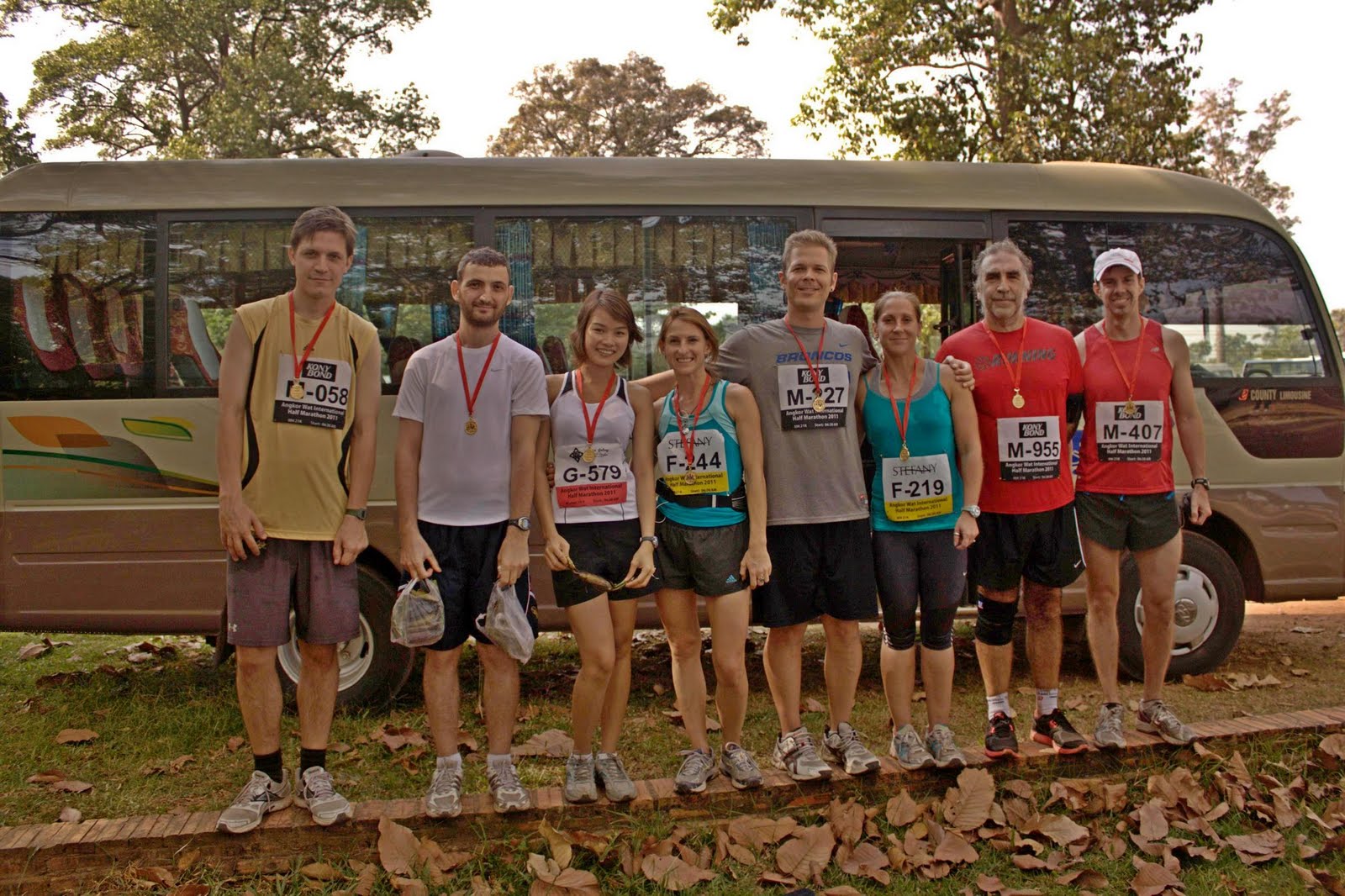
I reach the finish line and see some of my colleagues waiting there. The others came one by one and the final scene was an unforgettable moment for everyone. Limping, complaining, and whining about the various injuries while at the same time feeling satisfied deep inside with the achievement came along after 21 km of sweat, inner-talk and pain. Exhausted with the run and with the heat from the rising sun, we decided to get back our hotel rooms for some rest. Before getting on the bus we took several photos and for the last photo we handed the camera to a local young boy. At that moment, I thought “If he runs away with the camera now, none of us could go after him and catch him, considering our exhausted muscles :)” Fortunately, he was a good boy, not as naughty-minded as I was.

Despite the fatigue, we managed to have fun all afternoon, eating and drinking till late hours of Sunday evening. Someone asked while eating the quasi-happy pizzas and drinking the Angkor beers; “Shall we come here next year again?” The answer was a “BIG YESSSSSSS”...


*** Photos on this page are taken by Steve P, Hugh M, Fiona D, Curtis G and Andrew A. Thanks to all for giving me the photos and asking me to write this short article. This will be published in school's newsletter.

20 Kasım 2011

Koşmak ve Yazmak Üzerine


Haruki Murakami’nin “What I Talk About When I Talk About Running” adlı kitabını az önce bitirdim. Üretken bir romancı olan Murakami, aynı zamanda sıkı bir koşucu. Kitabı yazmayı bitirdiği 2008 yılına kadar, 26 maraton koşmuş, hayatını koşmak ve yazmak diye iki ana uğraşıya adamış, alabildiğine disiplinli ve varmak istediği hedefe rahatça kilitlenebilen birisi. Romanlarında genelde Japon halkının bireyci, yalnızlaştırılmış, kimi zaman trajik kimi zaman gülünç hayatlarını konu alan; absürd üzerinden ciddi edebiyat yapmaya çalışan, “The Wind-Up Bird Chronicle” dışındaki yapıtlarında, dünyadaki ya da ülkesindeki toplumsal sorunlara hemen hemen hiç değinmeyen bir yazar olarak tanımlanabilir kendisi. Genel olarak yalnızlığı, terkedilmişliği, arayışı, monotonlukta görülen kaosu işleyen, insanların iç dünyalarıyla ilgilenen bir romancı. Romanlarında tekrar eden sahneler şöyle sıralanabilir: asansörde ya da kuyu dibinde yalnız geçirilen gece ve ardından gelen büyük fiziksel/zihinsel değişiklik, kaybolan kedi ya da köpek, Yunan adalarında nedensiz yere yok olmak, pop kültüre yapılan göndermeler, jazz seven orta yaşlı ana karakterler, sıradışı huyları ya da alışkanlıkları olan kişilikler, aklın almayacağı tuhaf olaylar (gökten balık yağması, bir gecede ana karakterin tüm saçlarının beyazlaması gibi)... Sanırım şimdiye kadar beş romanını okudum Murakami’nin. En son Bangkok’dan öykü derlemesini almıştım ama öyküleri fazlasıyla post-modern, fazlasıya klişe bulduğum için üç-dört öyküden sonra bırakmıştım kitabı.
Kurgu yapıtlarını okumaya alıştığınız bir yazarın kurgu olmayan bir yapıtını okumak aslında kolay bir şey değil. Bir kere, ister istemez, ciddi bir önyargı oluşuyor kafamızın derinliklerinde. “Bu adam yine zırvalayacak, abuk subuk konulara girip, kendisinin ne kadar zeki, okuyucuların ne kadar aptal olduklarından dem vuracak.” gibisinden en büyük titanikleri bile batıracak azamette bir buzdağı var içimde, itiraf etmeliyim. Dolayısıyla, kitabı elime almadan önce ciddi ciddi mücadele verdim kendimle. Kitabın kısalığı ve bugünlerde bir yarı-maratona hazırlanıyor olmam, yardımcı oldu karar vermeme ve nihayetinde okudum. İki hafta sonra bir yarı-maraton koşmayacak olsaydım okurmuydum, bilemiyorum! Büyük bir olasılıkla okumazdım.
Kaygılarımın aksine mütevazi bir Murakami vardı bu kitapta. Ben benim, etten-kemikten bir insan yavrusu, ne fazla ne eksik! Ne yapmak istediğini bilen ve amacına ulaşmak için gereken her türlü fedakarlığı yapmaya hazır bir koşucu, yazar, vatandaş, koca, gezgin, müzik kolleksiyoncusu. “Acı kaçınılmazdır ama ıstırap çekmek bir seçenektir.” cümlesiyle hem koşmayı hem de yazarlığı özetlemiş, “Ne koşmak için ne de yazmak için ciddi bir nedenim yok” diyerek de yaşam felsefesini ortaya koymuş Murakami bu kitabında. Genel olarak kitapta anlatılanlar, bir maratona nasıl hazırlandığı, koşarken neler hissettiği, acıya karşı (özellikle kas ve diz ağrıları, çeşitli sakatlıklar, ara sıra nükseden arızalar) nasıl mücadele ettiği, koşu bittikten sonra duyduğu tatmin olmuşluk hissi, koşmadığı zamanlarda yazmaya ve diğer işlere nasıl yöneldiği gibisinden yazarın gündelik hayatının ayrıntılarından ibaret. Bunun dışında da pek bir şey yok. Yer yer yazarlık ve koşma üzerine paralellikler kuruyor olsa da bu sayfalar ya çok kısa ya da ciddi bir derinlikten yoksun. Yalnız ben yazarın bunu kasıtlı olarak yaptığını düşünüyorum çünkü yazarlar yazmak üzerine yazmayı sevmezler. Çünkü her yazarın yazma biçimi farklıdır ve bu bir çeşit meslek sırrıdır. Meslek sırlarını beraberlerinde mezara götürmek isterler. Çünkü bu sır onları ve yazdıklarını farklı kılar.
Yazarlığın ve koşmanın disiplin gerektiren uğraşılar oluşu, enerjinin yanında inadın ve dayanıklılığın önemli bir rolünün olduğu, zihinsel yoğunluğun sınırlarında gezmeden her iki uğraşıda da sona ulaşılamayacağı gibi koşutluklardan bahsediyor Murakami. Sonuç olarak umduğumu bulamadığım ama koşmaya hazırlanan entellektüel zihinlere tavsiye edebileceğim bir kitap bu. Koşmuyorsanız okumayın çünkü kitapta anlatılanların büyük bir çoğunluğu ancak uzun mesafe koşucularının anlayacağı türden iç konuşmalar ve tespitler. Yazarlık gibi bir amacınız olmasa bile eğer koşuyorsanız bu kitaptan alabileceğiniz ilhamlar olabileceğini söyleyebilirim. Sonuçta kitap koşmak üzerine bir iç hesaplaşma, koşmayı bir yaşam felsefesi haline getirmiş, takıntılı denilebilecek açık bir zihnin denize attığı bir şişe...
Yaklaşık son altı yıldır ben de koşuyorum. Her gün koşan birisi değilim ama fırsat buldukça koşmaya, kendimi o sessizlik denizine salmaya, ne aradığımı bilemeden yola çıkmaya çalışıyorum. Çünkü ancak koşarken, kafam, dalgalı bir denizde batmaktan kurtulmuş bir tahta parçası gibi kendi başına seyrediyor, sağa sola savruluyor, gözlerimin gördüğü şeylerden farklı anlamlar çıkarıyor. Benim için koşmak yazmanın ilk basamağı diyebilirim. Tabii ki yazdığım her öykünün ilk fikri koşarken gelmiyor aklıma ama pek çoğu koşarken gelişiyor ya da değişiyor. Koşarken nefes alıp vermeyi ritmik hale getirdikten ve hızı sabitledikten sonra (Bu genelde 2 km sürüyor benim için) insan bedeni açısından geriye ciddi bir sorun kalmıyor. Ondan sonrası dizler ve ayak bilekleri müsaade ettiği sürece devam etmek ve aklını yolun karanlığına bırakıp, hayalgücünü gökyüzüne salıvermek. Murakami’nin bu kitabını okumadan önce, onun yazdığı romanlardaki tuhaf konuları nereden bulduğu üzerine düşünmüştüm bir ara ve nasıl olduysa bu sorunun yanıtı bana yine koşarken gelmişti.
Bulduğum yanıt şuydu: Ancak koşarken gelir o karamsar ya da gülünç düşünceler insanın aklına. Ya uyurken ya da bedensel ağır bir yükün altındayken, rastlantısal diyebileceğimiz düşünce okları birbirlerini bulabilirler zihnin o engin uzayında. Uyurken de bedensel olarak kendimizi zorlarken de akıl bir süreliğine bizi terkeder. Geriye saçma sapan düşüncelerin işgaline açık, savunması delik deşik olmuş bir zihin kalır. İşte bu zayıf anda doğar o yaratıcı fikirler, en akla gelmez kavramlar birbirlerini rastlantısal olarak bulurlar, bir çeşit “random walk”, tıpkı atom hızlandırıcılarının tünellerinin içinde birbirleriyle çarpışan milyarlarca parçacık gibi çarpışır sıfatlar isimlerle, zarflar yüklemlerle. Gölde yüzen mavi bir kedi gülünç gelmez o anda, kente bir yılan gibi sokulan kızıl sel suları da...
Fakat iyi fikirler yetmez bir öyküyü, bir romanı başarılı yapmaya. O fikri geliştirmek, süsleyip püslemek, işe yarar hale getirmek gerekir. Bana göre Murakami bu noktada başarısız bir yazar. İyi fikirlerle kurguya başlayan ama bu fikirleri iyi işleyemeyen birisi. Yani bitirmek kadar nasıl bitirdiğine önem vermeyen bir yazar. Belki de bunda maraton koşucusu olmasının büyük bir etkisi vardır. Sonuçta koşarken nasıl koştuğunun, kimin için koştuğunun, kime ne mesaj verdiğinin bir önemi yoktur. Önemli olan 42.2 kilometrelik mesafeyi koşmak ve bitirmektir. Bunu kendisi de defalarca belirtiyor kitabında. Oysa benim için ne için yazdığım, kime ne mesaj vermek istediğim, en az hikayenin sanatsal güzelliği kadar önemli. Ne biçimi içeriğe kurban etmeyi ne de içeriği biçime kurban etmeyi kabul ediyorum. Okuyucu güzel bir yapıtı okumalı ve okurken zevk almalıdır. Aynı zamanda kitabı bitirip, raftaki yerine koyarken kafasında soru işaretleri olmalı; insanlığı, acıyı, aşkı, yaşamı, sanatı sorgulayan sorular zıplamalıdır zihninde. Aksi takdirde yazar ile hokkabaz arasında pek fark kalmaz. Birisi sahnedeki araç-gereciyle eğlendirir, diğeri kelimeleriyle. Eğlendirmek tabii ki güzeldir ama düşündürerek eğlendirmek daha güzeldir.
Kitabı okurken aklıma gelmedi değil, “Acaba ben yazsaydım böyle bir kitap, nasıl bir dil, nasıl bir yöntem seçerdim?”. Sanırım ben koşudan çok yazarlığa önem verir, aralarındaki koşutlukların daha bir altını çizer; yaşamı, yazıyı ve genel anlamda zorlukları sorgulayan bir deneme kitabı çıkarırdım ortaya. Tek sorun henüz ciddi bir koşu tecrübemin olmaması. O da zamanla olacak, yavaş yavaş birikecek bir şey. İğneyle kuyu kazmak nasıl roman yazmak için kıyas olabiliyorsa, maraton koşarken atılan her adım da maratonun tamamına kıyas olabilir. Ne romancı yazdığı romanın sonunu bilir başlarken ne de maratoncu 200 metre ileride kendisini nasıl bir yokuşun beklediğinin farkındadır. Bilmemek mutluluktur her ikisi için de! Bilmedikleri için hızlarını ve hırslarını koruyabilirler, bilmedikleri için devam etmeye hakları vardır, bilmedikleri için koşmak da yazmak da değerli uğraşılardır.
Bizler de bilmediğimiz için yarını bekleriz umutla, bilmediğimiz için bir sonrak sayfayı çeviririz heyecanla. Bilmediğimiz için yazarız kimi zaman. Tatmin olmak yazının son noktasını koymak, maratonun bitiş noktasına varmaktır. İyi bir yarış çıkarabildiysek, iyi bir yazıyı ortaya koyabildiysek ne mutlu bize.